By Dr. Timothy E. G. Bartel
Do you know how to read? Do you? Of course, if you’re looking at the words I’ve written here, and if you’re understanding what they mean, it seems most likely you can read. If you were not literate—and we must remember that the majority of humans who have ever lived were not literate—you wouldn’t even know that I’m asking you if you can read.
But the question “do you know how to read?” would have meant something a little different to those educated in the Orthodox world of the Byzantine Empire. From the fourth century onward, those educated in the great Roman capital of Constantinople would have been taught grammar using a little book called Techne Grammatica. The author of this book, Dionysius Thrax, defines “reading” in the following way:
“Reading is the rendering of poetic or prose productions without stumbling or hesitancy. It must be done with due regard to expression, prosody, and pauses. Through the expression
we learn the merit of the piece; from the prosody, the art of the reader; and from the pauses, the meaning intended to be conveyed.”
For an Orthodox student in 1st millennium Constantinople, reading was not merely the knowledge of what written words mean, but the art and skill of voicing written words aloud with clarity, understanding, and elegance. Much of the Techne Grammatica is concerned with the proper pronunciation of what the Greeks called “prosody.” In English the word prosody is usually used for the metrical structures of a poem, but the Greek word meant more than this: it meant any and all sonic qualities of words—long and short vowel sounds; acute, grave, and circumflex accents; singled and doubled consonants, etc. The music of Greek literature, whether poetry, history, or oratory—was a varied and complex music, and only those who could “perform,” so to speak, that music with their voices could be said to know how to read in the fullest sense.
We can sense this Byzantine understanding of reading when we hear a skilled actor perform a soliloquy from Shakespeare, or when we hear a recording of Dr. King or Bishop Kallistos intoning their powerful sermons. It is one thing to read on the page Tolkien’s words “All we need to do is decide what to do with the time that is given to us.” It is another to hear these words profoundly read in the warm and rich voice of Sir Ian McCellan in The Lord of the Rings.
–
I bring all this up because I’ve been exploring the fascinating world of Byzantine grammatical education, a tradition that stretched from the age of Constantine in the 4th century all the way up until the fall of Constantinople in the 15th century. As I read the words of Dionysius Thrax, which a thousand years of Orthodox grammar students would have read, I ask myself: Do I know how to read? Does my age know how?
The numbers are not always accurate, but the trends are clear: even at the basic skills of comprehending the meaning of written words, our culture is waning. We are becoming, as the experts say, post-literate; we are not illiterate, exactly; we know how to read and write, we just choose not too. With more resources for learning than all past ages combined, we are bored with learning. College students can’t be bothered to read whole books, so we assign them chapters. The chapters are too long, so we assign them a page or two. This they ignore as well, not because they cannot access the reading we assign, but because it doesn’t seem worth their while.
How different the past was. Take, for an example, the inheritance of the Techne Grammatica itself: first composed by Dionysius in Thrace around the 2nd century BC, and then edited into its current form for students in Constantinople by the 4th century AD, it provided the foundational principles for the study of grammar in both Greek speaking Constantinople and, eventually, Latin speaking Rome. But the Romans never read it directly. Instead, the 5th century AD Latin writer Priscian, who could read Greek, used the concepts of Dionysius to compose his own Latin Grammar. Priscian’s grammar would make its way west and become, by the middle ages, the core grammar textbook of the cathedral schools and, later, the great universities of Oxford, Cambridge and Paris. The greatest minds of early medieval Europe would have known of Dionysius’ Techne Grammatica only through Priscian’s Latin text. They would not have had any copies of—or have been able to read—Dionysius’s text. What a scholar in Rome would have given in, say, 1000 AD, to glimpse the Techne Grammatica! It would have been like something out of a legend. When the Greek texts of Orthodox Byzantium did end up in the West by the 14th century, they helped to revolutionise education and kick-start the renaissance.
You and I, on the other hand, can quickly pull up the Wikipedia Page on the Techne Grammatica, which will lead, through hyperlinks, to two public domain translations, both well edited. An Amazon search will also lead us to excellent scholarly commentaries on Dionysius Thrax. If I wanted to, I could assign the Techne Grammatica to my College students tomorrow, and they could immediately read and begin to study it.
It is hard to overestimate how entirely our culture does not care about this. Most students cannot be bothered to read AI summaries of Shakespeare plays, let alone Shakespeare plays themselves. Why then, oh why would anyone care about Dionysius Thrax?
–
Merit, Art, Meaning: this is what Dionysius says can be gained by truly reading well: “Through the expression we learn the merit of the piece; from the prosody, the art of the reader; and from the pauses, the meaning intended to be conveyed.”
We modern humans find ourselves within a mess of messages—some meant, some bent, most crippled by the greed of gold. Our dulled souls are precariously wedged between advertisements and propagandas designed to make us spiritually and materially poorer while remaining none the wiser. We are, in T.S. Eliot’s words, “distracted from distraction by distraction.” And the shadow of that Hideous Strength looms up and up.
What we need is Merit, Art, and Meaning, and to faithfully educate within this age is to stubbornly, to defiantly insist upon them. We would have our students—and ourselves—be not just those who can understand words on paper, but to be those who speak words well in public, who pronounce wisdom for the foolish, hope for the despairing.
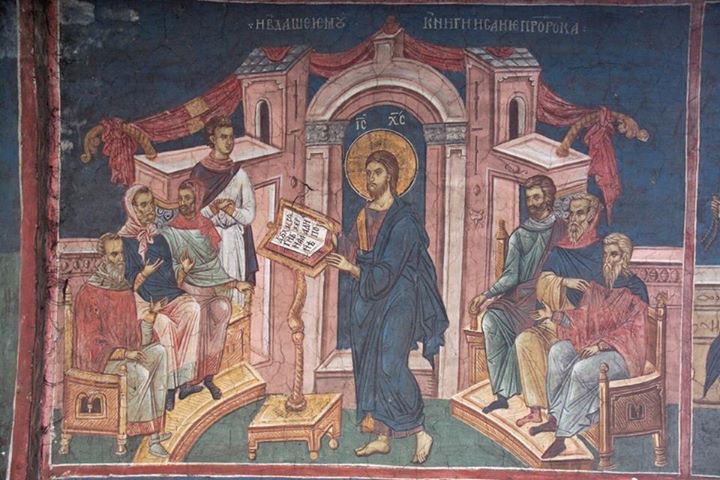
I am reminded that our Lord was himself an accomplished reader, and provides an example for us:
16Now Jesus went to Nazareth, where he had been brought up, and on the Sabbath day he went into the synagogue, as was his custom. He stood up to read, 17and the scroll of the prophet Isaiah was handed to him. Unrolling it, he found the place where it is written: 18“The Spirit of the Lord is on me, because he has anointed me to proclaim good news to the poor. He has sent me to proclaim freedom for the prisoners and recovery of sight for the blind, to set the oppressed free, 19to proclaim the year of the Lord’s favor.”1
This is what we read in Luke’s gospel. And so we ought to read.
- Luke 4:16-19 ↩︎
Leave a Reply